Gender Action-sponsored events and presentations by Elaine Zuckerman
EZ Presented: Financing Gender Equality - the Multilateral Development Banks
Forum: Global Days of Action for Tax Justice for Women
Date: March 20, 2024
Sponsors: Gender Action; Global Alliance for Tax Justice; SEATINI Uganda; Seinoli Legal Centre Lesotho; Centre for Applied Legal Studies South Africa
EZ Presented: Call for a Ceasefire in Palestine
Forum: Civil Society World Bank Action Day Demonstration at the 2023 Bank-Fund Annual Meetings
Date: October 13, 2023
Sponsor: Big Shift Global coalition of which Gender Action is a member
EZ presented: A critique of how the new draft World Bank gender strategy promotes gender roles in fossil fuel activities. The result is the Bank is removing the language about the draft’s promotion of fossil fuels
Forum: Meeting with World Bank Group Climate Directors
Date: October 12, 2023
Sponsor: World Bank
EZ moderated panel
Forum: World Bank-IMF Civil Society Policy Forum Panel, “A Macroeconomic Perspective of Gender and the BWIs: Lacking Focus in Times of Crisis” Speakers included Amal el Amri, National Secretary of the National Union of Morocco; Swasthika Arulingam, President of the Commercial and Industrial Workers Union of Sri Lanka; Anam Parvez, Head of Research Oxfam; and Bank and Fund macroeconomists Ekaterina Vostroknutova and Monique Newiak.
Date: October 12, 2023
Co-sponsors: Gender Action (lead sponsor); Bretton Woods Project; Akina Mama wa Afrika (AMwaA); CARE International; IBON; International Trade Union Confederation; Kvinna Foundation; Oxfam
Forum: World Bank-IMF Civil Society Policy Forum Panel, “An Evolution Roadmap Responsive to Development Crises? Towards an External Evaluation of the World Bank’s Cascade”
Date: October 11, 2023
Co-sponsors: Reality of Aid; Gender Action; ActionAid International; Christian Aid; Coalition for Human Rights in Development; European Network on Debt and Development; Boston University Global Development Policy Center; IBON International; Bretton Woods Project (BWP); Third World Network (TWN)
EZ presented: A critique of the IMF Gender Strategy
Forum: CSO meeting with Euro/Canadian IMF Executive Directors
Date: October 10, 2023
Sponsor: IMF Executive Directors
Forum: World Bank-IMF Civil Society Policy Forum Panel, “Transformative Policy Pathways: Lessons from Feminist Economics Programming for the IMF”
Date: Tuesday, October 10, 2023
Co-sponsors: AAI; Gender Action; Women’s Environment and Development Organization (WEDO); Global Alliance for Tax Justice (GATN); Centre for Economic & Social Rights (CESR); Southern and Eastern Africa Trade Information and Negotiations Institute; TWN; Recourse; MenaFem Movement for Economic Development and Ecological Justice (MENAFEM), BWP
EZ presented: A critique of the draft 2024-30 World Bank Group Gender Strategy
Forum: CSO meeting with Euro/Canadian World Bank Executive Directors
Date: October 9, 2023
Sponsor: World Bank Executive Directors
Role: Gender Action co-organized this celebration for feminists from around the world
Forum: Feminist Activists Evening at Cadi Ayyad University Club
Date: October 8, 2023
Co-Sponsors: ActionAid International (AAI); AMwaA; BWP; CESR; Gender Action; IBON International; MENAFEM; Oxfam; WEDO
EZ presented: How World Bank “stakeholder engagement” demonstrates that the Bank adopts CSO language rhetorically without adopting it in practice; and a critique the Bank’s draft gender strategy for ignoring austerity, debt and privatization that harm poor women’s lives and livelihoods.
Forum: Reclaim our Future Conference - Morning Plenary at Cadi Ayyad University Club
Date: October 8, 2023
Co-Sponsors: Arab Group for the Protection of Nature; Arab Network for Food Sovereignty; Asia Pacific Forum on Women, Law & Development; IBON International; IMF-WBG Out of Recovery; International League of People’s Struggle; International Indigenous People’s Movement for Self-Determination and Liberation; MENAFEM; Nawat Institute; People’s Coalition on Food Sovereignty; People Over Profit; Reality of Aid Network
EZ presented: How structural adjustment causes economic impoverishment; weakens public sectors; reduces public health, education, infrastructure and technology investments; and increases environmental damage with women bearing the brunt of these harms.
Forum: End Austerity Festival at Cadi Ayyad University Club, Marrakech
Date: Saturday, October 7, 2023
Co-Sponsors: End Austerity Campaign; Global Alliance for Tax Justice (GATJ)
EZ Presented: Unpacking the World Bank Gender Strategy from a Human Right’s Perspective
Forum: Reclaim our Future Campaign
Date: September 19, 2023
Sponsors: Asian Pacific Women Law & Development; IBON International
EZ Presented: How International Financial Institutions Treat Gender
Forum: Heinrich Boell Foundation Global Delegation
Date: September 14, 2023
Sponsor: Heinrich Boell Foundation
EZ Presented: World Bank & IMF Gender Advocacy: History, Strategy, Tactics
Forum: Gender-IFI Summer School
Date: August 2, 2023
Sponsor: Bretton Woods Project
EZ Presented: The gendered impact of IMF austerity conditionalities
Forum: The gendered impact of austerity
Date: July 7, 2023
Sponsor: EuroMed Rights; Arab Watch Coalition; the Women’s Budget Group; Gender Action
Link to video: https://fb.watch/lI_7mECy_8/
EZ Presented: World Bank & IMF Imperial History
Forum: World Bank & IMF – Tools Of Empire
Date: June 12, 2023
Sponsor: War Industry Resisters Network
EZ Presented: Austerity, Debt and Privatization are Ignored by the World Bank Gender Team
Forum: World Bank-IMF Civil Society Policy Forum Panel: Gender - Time to get Macro
Date: April 14, 2023
Co-Sponsors: Bretton Woods Project; Gender Action
EZ Presented: The case for a heterodox feminist World Bank President
Forum: World Bank-IMF Civil Society Policy Forum Panel: Examining the World Bank president selection process in the light of the Bank’s Evolution Roadmap
Date: April 12, 2023
Co-sponsors: African Sovereign Debt Justice Network; Heinrich Boell Foundation; Arab Watch Coalition; TWN; Right to Education Initiative; Latindadd, Gender Action; Protection International Mesoamérica; AAI; Big Shift; Recourse; Accountability Research Center; Christian Aid; Urgewald; E3G; and Eurodad
EZ Presented: World Bank Group approaches to gender and climate including the draft Evolution Roadmap's gender blindness
Forum: “The World Bank Group Reform Process: More of the Same or a Real (R)Evolution?”
Date: March 20, 2023
Co-sponsors: Heinrich Boell Foundation; Urgewald
IFIs' false (climate) solutions and paving the path for corporate recovery
Forum: Civil Society Caucus for Climate Justice: a post-COP27 event
Date: November 19,2022
Co-Sponsors: Ibon International; Moroccan Coalition for Climate Justice
Fit for purpose? IMF gender mainstreaming strategy and taxation approaches during multiple intersecting crises
Forum: World Bank-IMF Civil Society Policy Forum
Date: October 12, 2022
Co-sponsors: ActionAid, Third World Network, Gender Action and others
How the World Bank is contributing to our planet’s climate crisis
Forum: Reading the fall 2022 IPCC report to President Malpass and World Bank staff together with many other climate activists including Bill McKibbon and many others
Date: September 27, 2022
Co-sponsors: 350.org For People for Planet; Glasgow Actions Team
Webinar: Analyzing the Gender Dimensions of International Financial Institution (IFI) Investments
Forum: Capacity building workshop for Fair Finance Asia members from Cambodia, Indonesia and the Philippines
Date: June 29, 2022
Sponsor: Fair Finance Asia, Oxfam Novib
Presentation to IFC Managers on the Greening Equity Approach (GEA)’s Gender-Blindness and Continuing Fossil Fuel investments’ inordinately harmful long-term impacts on women
Forum: CSO IFC-watchers meeting with IFC managers on the GEA
Date April 29, 2022
Sponsor: International Finance Corporation
GRID or greed? Accountability & the World Bank Group’s recovery agenda
Forum: Civil Society Critique of the World Bank Group’s Green, Resilient, Inclusive Development (GRID) framework – its response to the current global crises
Date: April 19,2022
Co-Sponsors: IBON International; The Reality of Aid; People Over Profit; Society for International Development; People’s Coalition on Food Security; Bretton Woods Project; Eurodad; International Indigenous Peoples Movement for Self-Determination & Liberation; Asia Pacific Research Network; Gender Action
More Than an Add-On? Centering gender equality in climate investments
Gender Action and the Heinrich Boell Foundation Washington co-sponsored an event at the 2022 UN Commission on the Status of Women presenting findings of an in-depth evaluation of gender integration in Green Climate Fund projects and programs and recommending ways to improve their gender responsiveness.
Watch the event here: https://www.youtube.com/watch?v=dWbM4wVB6VM
Date: March 23, 2022
Gender Action hosted a webinar for civil society groups who demand accountability and justice from IFIs, particularly related to ending harmful climate impacts, that can be strengthened by integrating an intersectional gender lens. We used the AIIB as our advocacy example on holding IFIs accountable on combined gender and climate impacts. See panelists Bhumika Muchhala, Eliza McCullough and Mariama Williams illuminate why and how to do so.
Date: January 11, 2022
AIIB’s weak attention to gender issues and harmful gender-climate impacts
Forum: Workshop with the Asian Infrastructure Investment Bank Executive Board Members
Date: October 18, 2021
Co-Sponsors: ALTSEAN-Burma; Coastal Livelihood and Environmental Action Network Bangladesh; Coalition for Human Rights in Development; Gender Action; Growthwatch India; Just Finance; Coalition for Monitoring Infrastructure Indonesia; NGO Forum on ADB; Recourse; Rivers without Borders Asia; Urgewald
EBRD Needs to Combine Gender and Climate Issues
Forum: Gender and Human Rights at the European Bank for Reconstruction and Development
Date: October 15, 2021
Co-Sponsors: CEE-Bankwatch; EBRD
ADB Must Strengthen Gender-Climate Safeguards
Forum: ADB Workshop with Civil Society
Date: October 13, 2021
Sponsor: Asian Development Bank
Building a feminist recovery for all: Gender transformative policies are more urgent than ever
Forum: World Bank Civil Society Policy Forum
Date: October 1, 2020
Co-Sponsors: Gender Action; ActionAid UK, ActionAid, Fight Inequality Alliance, International Women’s Rights Action Watch Asia Pacific, Bretton Woods Project, Kvinna till Kvinna, Oxfam
See transcript at: https://www.brettonwoodsproject.org/2020/10/building-a-feminist-recovery-for-all-gender-transformative-policies-are-more-urgent-than-ever/
World Bank Development Policy Financing: implications for a just, green and feminist recovery
Forum: World Bank Civil Society Policy Forum
Date: September 29, 2021
Co-sponsors: Gender Action; Eurodad; Bretton Woods Project; Reality of Aid; Sustainable Development Policy Institute
Developing Ecofeminist Indicators
Forum: Global Feminist Frameworks - Climate Justice Town Hall
Date: September 24, 2020
Co-Sponsors: FemNet, DAWN, Just Associates, WoMin and others
Applying Ecofeminist Indicators to the Green Climate Fund
Forum: IFIs - Assessing Gender Impacts
Date: September 23, 2020
Co-Sponsors: African Monitor; Oxfam South Africa
Assessing Development Finance Institutes (with the Fair Finance Guide methodology)
Date: July 16, 2020
Co-Sponsors: Centre for Environmental Rights; Fair Finance International; Oxfam Novib; Profundo
Watch Zuckerman starting at around 50 minutes:
https://oxfam.app.box.com/s/3bbrjg6cy776nm2vkinn24x4d834dni5
Ensuring Project NonDiscrimination Based on Sexual Orientation, Sex Characteristics and Gender Identity (Co-Moderator with Neela Ghoshal of Human Rights Watch)
Forum: World Bank Civil Society Policy Forum
Date: October 17, 2019
Co-Sponsors: Gender Action; Council for Global Equality; Bank Information Center Europe; Human Rights Campaign; Human Rights Watch
Asia Infrastructure Investment Bank (AIIB): Needed Gender and Climate Policies and Country Case Presentations (Moderator)
Forum: CSO exchange with Canada’s Executive Director at the AIIB Annual Meeting, Luxembourg
Date: July 11, 2019
Sexual Orientation and Gender Identity - Considering Risk Mitigation in World Bank Programming
Forum: World Bank Civil Society Policy Forum
Date: April 12, 2019
Sponsors: Council for Global Equality; Gender Action; Bank Information Center Europe; Human Rights Campaign
Responding (or not) to IFI Gender Risks: Examples from Haiti Projects
Forum: World Bank Civil Society Policy Forum
Date: April 10, 2019
Sponsors: Accountability Counsel; Bank Information Center; Gender Action
Gender Impacts of the IFI Privatization Agenda
Forum: UN Commission on the Status of Women
Date: March 13, 2019
Sponsors: Global Alliance for Tax Justice including ActionAid; Asian People’s Movement on Debt & Development; AWID; Bretton Woods Project; Christian Aid; DAWN; Gender & Development Network; Womankind and others
Gender and IFIs Haiti
Forum: Briefing to US Congress Freshman Representatives
Date: February 6, 2019
Gender and IFIs China
Forum: Heinrich Boell Foundation China, Beijing
Date: November 19, 2018
Sexual and Gender-Based Violence Against LGBTI People
Forum: World Bank Spring Meetings Civil Society Forum
Date: April 17, 2018
Sponsors: Gender Action; Bank Information Center Europe; ERA - LGBTI Equal Rights Association for Western Balkans and Turkey; KOURAJ, Haiti; World Bank GSURR - SOGI Unit
Speakers: Charlot Jeudy, Kouraj; Liridon Veliu, ERA; Clifton Cortez, the World Bank
Moderator: Elaine Zuckerman
Elaine Zuckerman Interviewed by Professor Christina Jenq on China in the 1970s and Gender Advocacy Today
Forum: New York University, Shanghai
Date: October 27, 2017
Gender in the New Development Bank Environmental and Social Framework
Forum: New Development Bank
Date: October 25, 2017
Gender and Environment Advocacy on the International Financial Institutions
Forum: Both ENDS, Amsterdam, the Netherlands
Date: June 22, 2017
International Financial Institutions, Women’s Rights and Environmental Justice
Forum: Eurodad Conference, The Hague, the Netherlands
Date: June 20, 2017
Forum: Oxfam Strategic Dialogue on Gender Justice & the Extractive Industries
Date: March 23, 2017
Women’s Rights in Haiti – How do IFIs Perform?
Forum: Haiti Advocacy Working Group International Women’s Day Panel (moderator: Elaine Zuckerman; presenters: Sabine Lamour, SOFA, Haiti, and Nadia Lafleur, Famn Deside, Haiti)
Date: March 7, 2017
Sponsors: Gender Action; Human Rights Watch
IFI Infrastructure Projects Having Harmful Gender Impacts
Forum: New York University, Shanghai Campus
Date: December 8, 2016
Gender Impacts of an Influx of Workers in World Bank Infrastructure Projects
Forum: World Bank Spring Meetings Civil Society Forum
Date: April 14, 2016
Financing for mega-infrastructure in Africa
Forum: WoMin gender and extractives regional alliance: African Women Uniting for Energy, Food and Climate Justice! - Exchange and Strategy Meeting
Location: Niger Delta, Nigeria
Date: September 30, 2015
Strategies for Achieving Women’s Economic Empowerment
Forum: UN General Assembly First Ladies Forum
Location: New York City
Date: September 19, 2015
Role and Challenges for Women in Agricultural Development
Forum: Plenary Session at the Global Development Network Conference on ‘Agriculture for Sustainable Growth: Challenges and Opportunities for a New ‘Green Revolution’
Location: Casablanca, Morocco
Date: June 11, 2015
Presenter: Elaine Zuckerman
Gender Impacts of IFI Structural Adjustment Programs
Forum: American University Graduate Gender and Conflict Program
Location: Washington DC
Date: February 2, 2015
Role of Women’s Rights in International Financial Institution Investments
Forum: Georgetown University Law Center Women's Law and Public Policy Fellowship and Leadership and Advocacy for Women in Africa Program
Location: Washington DC
Date: January 22, 2015
Aid Accountability of the US and IFIs in Post-Earthquake Haiti
Forum: US Congress Freshman Representatives Haiti Briefing Five Years After the Earthquake
Location: Washington DC
Date: January 12, 2015
Potential World Bank Inspection Panel Gender Discrimination Cases
Forum: World Bank Inspection Panelists and Secretariat
Location: Washington DC
Date: December 16, 2014
Women’s Rights and Gender Justice in Global Development
Forum: Plenary Session at the Global Development Network Conference on ‘Structural Transformation in Africa and Beyond’
Location: Accra, Ghana
Date: June 18, 2014
Gender Action's Advocacy Strategies
Sunday, May 18, 2014
Promundo Planning Meeting
Gisenyi, Rwanda
Elaine Zuckerman categorized Gender Action's advocacy strategies as (1) official -- when Gender Action informs relevant IFI staff what issues we are monitoring, for example the extent to which World Bank investments in post-conflict reconstruction investments address gender roles and promote women's and men's equal rights, requests hard-to-obtain project information and invites comments; and (2) unofficial - when Gender Action analyzes gender impacts of IFI investments in themes such as food security, gender-based violence, and extractive industries based on publicly available IFI project documents, often accompanied by fieldwork surveys conducted with local partners, followed by surprising IFI staff when we publicize our research findings, catching IFIs off guard. Both approaches can be an effective strategies, especially the unofficial approach's shaming effect.
In-Country Situations for LGBT Communities
April 11, 2014
World Bank Civil Society Forum
1850 I St NW
Washington, DC 20433
Gender Action co-sponsored a panel featuring Executive Directors of LGBT advocacy organizations who described challenges facing their communities. Panelists included Kelly Verdade of ELAS, Brazil; Ying Xin of the Beijing LGBT Center, China; Wei Xiaogang of the Beijing Gender Health Education Institute, China; Jonas Bagas of the TLF Sexuality, Health and Rights Educators Collective, the Philippines; and Simran Shaikh of the New Delhi HIV/AIDS Alliance, India.
Gender & SOGI Safeguard Panel
April 9, 2014
World Bank Civil Society Forum
1850 I St NW
Washington, DC 20433
Gender Action co-sponsored a panel promoting a first-ever mandatory rights-based Gender and Sexual Orientation and Gender Identity (SOGI) Safeguard Policy, to prevent discrimination in Bank investments.
Building Back by Half? Gender Issues in IFI Investments in Post-Earthquake Haiti
Wednesday, November 20, 2013
220 42nd St.
New York, NY 10017
Elaine Zuckerman and Falonne Conte from Université d'Haiti (via Skype) shared findings of a recent study for the UN Women Policy Division's Brownbag Series. The study assessed the extent to which investments made by International Financial Institutions, the World Bank and the Inter-American Development Bank, respond to the needs of women in post-earthquake Haiti.
October 11, 2013
The World Bank
1850 I St NW
Washington DC 20433
Panelists reflected on the 10th anniversary of the World Bank-sponsored project, its flaws and lessons for future energy projects. Gender Action’s 2011 report, Broken Promises: Gender Impacts of the World Bank-Financed West-African and Chad-Cameroon Pipelines highlighted the pipelines’ negative gender impacts. Gender Action President Elaine Zuckerman was joined by Delphine Djiraibe of Chad’s Public Interest Law Center (PILC) and Peter Rosenblum of the Columbia Institute for Human Rights. Urgewald’s Korinna Horta was moderator.
Thursday, October 10, 2013
The World Bank
1850 I St NW
Washington, DC 20433
This panel discussion was co-sponsored by Gender Action, ActionAid and the Unitarian Universalist Service Committee to present assessments of donor aid in Haiti following the January 2010 earthquake. Gender Action's Claire Lauterbach was joined by Doudou Pierre Festile from the National Haitian Network for Food Sovereignty and Food Security (RENHASSA); Rosnel Jean-Baptiste from the Tet Kole Ti Peyizan peasant coalition; and a Yale Law School speaker who discussed UN responsibility for Haiti's cholera outbreak and donor actions to date. ActionAid's Doug Hertzler was moderator.
Brown Bag Lunch Presentation at Conservation International
Tuesday, August 27, 2013
Conservation International
2011 Crystal Dr, Suite 500
Arlington, VA 22202
Elaine Zuckerman and Sarah Little presented Gender Action's recent climate change and extractive industry publications and initiatives at a brown bag lunch with Conservation International.
Brown Bag Lunch Presentation at the Bank Information Center (BIC)
Friday, March 15, 2013
Bank Information Center
1100 H Street, NW, Suite 650
Washington, D.C. 20005
Elaine Zuckerman, Sarah Bibler and Claire Lauterbach presented Gender Action's recent work at a brown bag lunch with the Bank Information Center (BIC).
IFI Policies & Practice:
How to Fill the Gender Gaps
Friday, April 19, 2013
12:45 pm - 2:00 pm
World Bank Civil Society Forum Room: MC C1 - 200
1818 H St NW, Washington, DC
Gender equality is a core International Financial Institution (IFI) development objective to achieve poverty eradication. However, grassroots reports and testimonies show that women too often do not benefit from IFI-financed development efforts. Many IFI projects still neglect and often violate women's rights.
This Panel explored gaps between IFI gender policies and realities faced by women and men in IFI client countries. It examined ways to overcome challenges to improving and implementing gender policies. The Panel also assessed the gender implications of the World Bank safeguard policies review currently underway. It asked how the safeguard policies can protect women's rights from operational impacts and risks. Moreover, the panel considered fundamental IFI approaches necessary to achieve genuine gender equality and to make IFI interventions gender-responsive.
Speakers:
- Liane Schalatek, Heinrich Boell Foundation
- Titi Soentoro, Aksi!
- Elaine Zuckerman, Gender Action
- Claire Lauterbach, Gender Action (Moderator)
Congressional Briefing: "The Economic Return from Investing in Care Work and Early Childhood Education"
Wednesday, March 20th
12:00pm - 2:00pm
Rayburn House Office Building, Room B340
The Caring Economy Campaign (CEC) of the Center for Partnership Studies (CPS), together with CEC member Gender Action and other co-sponsors, held a Congressional Briefing on "The Economic Return from Investing in Care Work and Early Childhood Education." The event featured a presentation by Dr. Riane Eisler highlighting the CPS-Urban Institute report: National Indicators and Social Wealth.
Thursday, February 14th, 2013
12:00pm - 2:00pm
Farragut Square
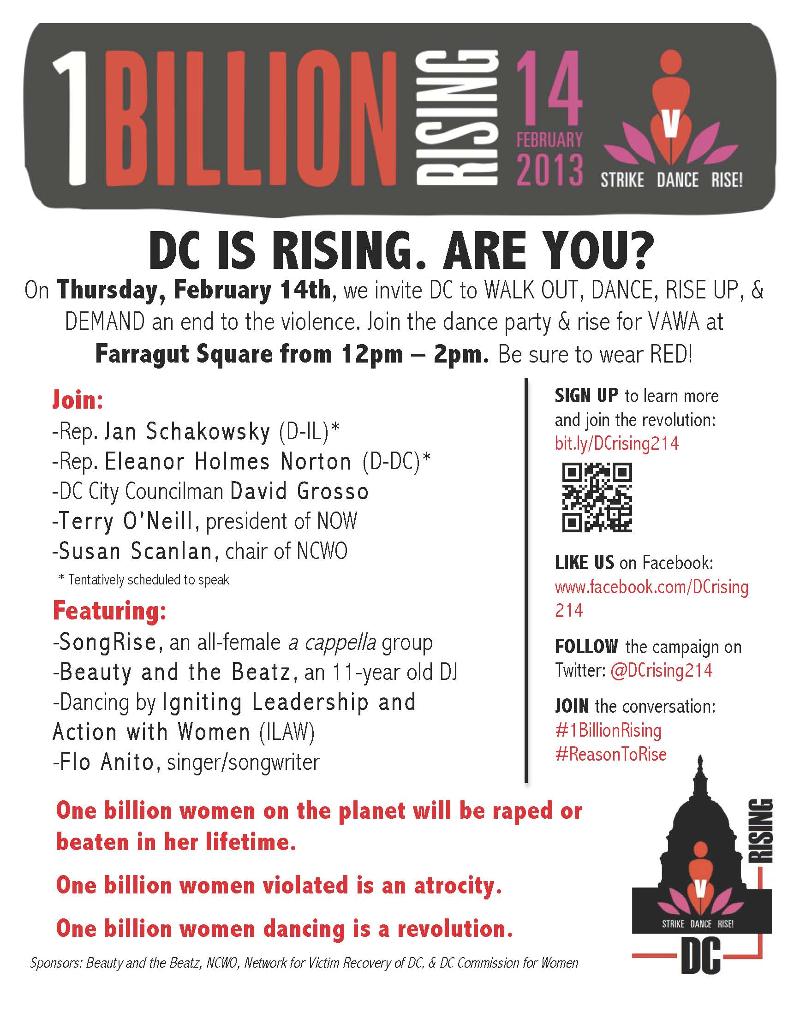
NCWO and Gender Action held a rally on Valentine's Day 2013 to join with women and those who love them all over the world, inspired by Eve Ensler's call for a global protest against gender-based violence and rape culture.
Click here to see the event flyer with additional information.
Monday, February 4th − Tuesday, February 5th, 2013
Cannon and Rayburn House Office Buildings
Washington, DC
Gender Action, the Haiti Advocacy Working Group, Haitian partners and Congressional allies held events on February 4th and 5th to assess the state of the reconstruction and discuss the way forward for Haiti. Gender Action’s own Claire Lauterbach presented the results of our study of IFI investments post−earthquake and their gender sensitivity.
Banking on Health Panel Discussion
Wednesday, October 10th, 2012
12:30-2:00pm
World Bank and IMF Annual Meetings in Tokyo, Japan
Tokyo International Forum, Room 253
At the World Bank and IMF Annual Meetings in Tokyo, Japan, Gender Action's Claire Lauterbach discussed the report - "Banking on Health: Evaluating World Bank and African Development Bank Investments in Reproductive Health and HIV/AIDS in Africa" - evaluating the quality and quantity of these banks' efforts from 2006-2012 to achieve good reproductive health and fight HIV/AIDS in sub-Saharan Africa. She was joined by Dr. Joan Awunyo-Akaba (Director of Future Generations International) who discussed the successes and failures of reproductive health and HIV/AIDS in Africa. Jessica Espey, Senior Research and Policy Adviser at Save the Children, reflected on gender in the post-MDG development agenda. Dr. Nahid Toubia, Sudanese women's health expert and Associate Professor at Columbia University School of Public Health was chair.
AIDS-free Generation? Not Without Women
Thursday, June 21st , 2012
5:30pm-7:30pm
International Center for Research on Women
1120 20th St NW
Suite 500 North
Washington, D.C. 20036
Women account for more than half of the world's population living with HIV - yet they are at the fringes of prevention and care programs. The statistics make it clear: We can't create an AIDS-free generation without women. Join us to discuss women, HIV, and what it will take to create an AIDS-free generation.
Panelists discussed the impact of HIV and AIDS on women in the U.S. and globally, and the upcoming International AIDS 2012 Conference (July 22-27) at the D.C. Convention Center, and how women's health and rights advocates can join global efforts to advance women's health and rights in the fight against HIV and AIDS.
The event was sponsered by: Gender Action, The National Council of Women's Organizations (NCWO) Global Issues Task Force, the Center for Health and Gender Equity (CHANGE), and the International Center for Research on Women.
Wednesday, May 23rd, 2012
5:00-7:00pm
Embassy of Finland
3301 Massachusetts Ave NW
Washington, DC 20008
Riane Eisler, the author of The Real Wealth of Nations: Creating a Caring Economics, was in Washington, DC to discuss her approach to economics, called the Caring Economy, which "gives visibility and value to the most essential human work: the work of caring for people and the planet." Gender Action's own, Sarah Bibler, was asked to share a few words on the Caring Economy Leadership Program, of which she is currently a student.
Speakers Included:
Dr. Riane Eisler, President, Center for Partnership Studies
Erwin de Leon, Center on Nonprofits and Philanthropy, The Urban Institute
Dr. Sara Melendez, Board Member, Ms. Foundation for Women
Her Excellency, Ambassador Ritva Koukku-Ronde
Tuesday, May 22nd, 2012
1:00PM
Fordham Institute
1016 16th St NW # 700
Washington, DC 20005
This seminar presented young women with the chance to hear from professionals in the international public policy field and explore their own career paths. Elaine spoke on poverty, women's role in economic development, and how International Financial Institutions address these issues.
Speakers:
Elaine Zuckerman, Gender Action
Seema Jalan, Women Thrive
For more details on the seminar, click here.
Whither Poverty & the Millennium Development Goals: World Bank Futures 2030 and Beyond
Thursday, May 17th, 2012
6:00PM -9:00PM
Hilton Garden Inn
7301 Waverly Street
Bethesda, MD 20814
A DIALOGUE ON THE WORLD IN 2030 AND THE WORLD BANK's PLACE IN IT!
In 2000, when the Millennium Development Goals (MDGs) were launched, optimism was high. The MDGs called for HALVING global poverty and other laudable goals by 2015… and for sure the actions and activities of the World Bank (and other IFIs) were supposed to help countries get there. Subsequently, the World Bank simplified its reason for existing to four words! A WORLD WITHOUT POVERTY! BUT as we approach the MDG dateline, a key question is emerging: WHAT NEXT?
Speakers addressed questions like - Do the MDGs still reflect what is important about how development happens? What will an end to poverty mean in 2030? What will be role of the World Bank? What will its successes and/or failures be?
Moderator: Claire A. Nelson Ph.D.
Special Guests:
Daniel Runde
Elaine Zuckerman
Walker Williams
12th AWID International Forum - Understanding International Financial Institutions & Gender: An Economic Toolbox
Thursday, April 19th - Sunday, April 22nd, 2012
Halic Congress Center
Istanbul, Turkey
- Understanding International Financial Institutions & Gender: An Economic Toolbox Training Session - Thursday, April 19th, 11:30 AM - 1:00 PM
- Gender Action Goes Global: Launching a Worldwide Network of IFI Gender Watchers (Evening Reception) - Thursday, April 19th, 6:00 PM - 8:00 PM
- The Importance of Capacity Building on Economics and Women's Rights: Challenges, Gaps, and Opportunities (Roundtable) - Friday, April 20th, 11:30 AM - 1:00 PM
- Voices of Experience: Activists and Academia Share their Experiences, Stories of Motivation, Leadership & Strategies (Roundtable) - Saturday, April 21st, 11:30 AM - 1:00 PM
- Forum-long Campaign Corner to promote the Worldwide Network of IFI Gender Watchers - Thursday, April 19th through Sunday, April 22nd
World Bank Climate Investment Funds Four Years Later: Learning Lessons for the UN's Green Climate Fund
Thursday, April 19, 2012
10:30 AM - 12:00 PM
Friends of the Earth - 1100 15th Street NW, 11th Floor
Washington, DC
Sarah Little presented a gender analysis of the World Bank's Pilot Program for Climate Resilence under the Climate Investment Fund.
To see the the Bretton Woods Project's minutes of the meeting, click here.
WREI Congressional Women Fellows Presentation March 19, 2012
Washington, DC
Elaine Zuckerman was invited to speak and engage with this year's Women's Research and Education Institute Fellows. The Fellows are a select number of graduate students with a proven commitment to equity for women. She focused on Gender Action's work and her own career experience working in public policy. To view her remarks, click here.
International Women's Day Presentation Hosted by Cate Muther (Three Guineas Fund Chair) March 8, 2012
San Francisco, CA
Elaine Zuckerman was invited to speak at a reception hosted by Cate Muther on International Women's Day. She touched on Gender Action's history, current projects and how the organization is "breaking down silos." To view her remarks, click here
Haiti Earthquake 2-Year Public Commemoration Events January 23-25, 2012
Rayburn House Office Building
Independence Ave and South Capitol St
Washington, DC 20003
The Haiti Advocacy Working Group, Haitian social movements and Haitian Diaspora groups are working with the U.S. Congressional allies, including members of the Congressional Black Caucus, to raise attention to the current status of Haiti’s reconstruction process at the 2 year commemoration marker. From January 23-25, 2012, Haitians, Haitian-Americans and other Haitian development experts brought their voices to Capitol Hill. HAWG allies advocated for a just reconstruction and development process in Haiti, one that prioritizes the needs of women, internally displaced persons, smallholder farmers, the urban poor, immigrants and other vulnerable Haitians, includes the full participation of Haitian grassroots groups and the Diaspora and holds the US government accountable for delivery of its commitments.
See the full schedule here. (pdf)
For more information on the two year events, click here.
Gender Equity and Sustainable Development: Prioritizing Actions to Achieve Results
January 19, 2012
8:30am-5:00pm
1400 16th St. NW, Conference Center, 1st Floor
Elaine Zuckerman moderated the Enabling Economy for Gender-Equitable Sustainable Growth Roundtable at the daylong Gender Equity and Sustainable Development Conference, co-sponsored by Gender Action, the Heinrich Boell Foundation, ActionAid, the Institute for Agriculture and Trade Policy, and Oxfam. Roundtable members included Radhika Balakrishnan, Executive Director, Center for Women's Global Leadership, Rutgers University; Aldo Caliari, Director, Bretton Woods Project, Center of Concern; Tim Scott, Human Development Report, UN Development Program (UNDP); and Jeni Klugman, Director of the Gender and Development Unit, The World Bank.
Roundtable members advocated that diminishing public social sector investments and services must be viewed through a human rights lens, for ending discrimination against women in labor markets and property access, and supporting budgeting to address the unpaid caring economy.
Click here to access the event page on Heinrich Boell Foundation's website
Click here to access the program and list of expert speakers (pdf)
The Public Leadership Education Network's "Women in Public Policy" Seminar
January 9-13, 2012
Washington, DC
According to the White House Women in America Report, only 14 percent of those working in management, business, and finance jobs are women. Through the Public Leadership Education Network’s “Women in Public Policy” seminar, experienced women helped young professionals discover how finance and business are regulated, how programs and initiatives are funded and the role of the global economy. Elaine Zuckerman spoke on International Finance and Social Justice. To view her remarks, click here.
Food Insecurity and the Gender Divide: Haiti and Kenya
November 29, 2011
Kenyan Embassy, Washington, D.C.
NCWO's Global Women's Issues Task Force, the Kenyan Embassy and Gender Action held an event on gender, food insecurity, and the International Financial Institutions (IFIs). Soaring global food prices are increasing hunger and the burden of the poor, of whom women compose the majority around the world. Women also constitute the majority of the world's farmers who are primarily responsible for their household's food security. The event examined the gender dimensions of food insecurity, with a special focus on Kenya, Haiti and IFIs.
Featured Speakers:
His Excellency Elkanah Odembo, Kenyan Ambassador to the U.S.
Jacqueline Morette, Farmer and President of the United Women's Association of Poully, Haiti
Elizabeth Arend, Programs Coordinator and Gender and Food Insecurity Lead, Gender Action
The Gender Dimensions of World Bank Aid
September 30, 2011
WIDER-UN UniversityElaine reviewed the gender impacts of World Bank food security, SRHR/HIV, post conflict and especially pipelines investments. She recommended inter alia that the Bank replace its weak gender policy with a strong mandatory policy and enforce it; expand and deepen its gender expertise; stop privatizing social services which denies poor people access to health and water; stop financing dirty oil and gas pipelines that benefit oil companies but harm poor women, men, boys and girls.
Panel Discussion: The Gender Impacts of the Chad-Cameroon Oil Pipeline and the West African Gas Pipelines
September 22, 2011
Carnegie Endowment for International Peace Conference CenterGender Action and Friends of the Earth International teamed up in 2010 to conduct a gender analysis of the pipelines in Cameroon, Nigeria, Togo and Ghana, an initiative that represents one of the only efforts to highlight women's priorities and perspectives in areas traversed by the pipelines. Based on fieldwork, our analysis reveals that, while IFIs provided financial security to the oil and gas multinational companies that profited from pipeline development, they failed to adequately protect vulnerable social groups in affected communities, particularly women. Consequently, these gender-blind investments increased women's poverty and dependence on men; caused ecological degradation that destroyed women's livelihoods; discriminated against women in employment and compensation; excluded women in consultation processes; and led to increased prostitution. Panelists:
Betty Abah, Friends of the Earth Nigeria
Eimi Watanabe, World Bank Inspection Panel
Korinna Horta, Urgewald
Sonia Lowman, Gender Action
Moderator:
Liane Schalatek, Heinrich Boell Foundation
Read the report
Watch video from this event
Gender WDR 2012 Roundtable Brainstorming Session
September 22, 2011
Carnegie Endowment for International Peace
Coinciding with the 2011 annual World Bank fall meeting, Gender Action hosted a civil society brainstorming session on the World Bank's Gender Equality and Development World Development Report (WDR), which was released on September 19th. We hope you will be able to join us!
Anti-Rape Rally at International Monetary Fund
Remarks by Elaine Zuckerman
Gender Action
May 18, 2011
Elaine spoke at an anti-rape rally outside the IMF to call for IMF Chief Dominque Strauss-Kahn's resigination. See her remarks here.
World Bank, Energy Finance, and Climate Change: Something Old. Something New
Thursday, April 14, 2:00 - 3:30 pm Because addressing climate change remains a global imperative and a critical gender justice issue, Gender Action co-sponsored a panel at Friends of the Earth International to examine energy access and World Bank energy financing. Gender Action arranged for Tito Soentoro of the Philippines based NGO Forum on the ADB to address the gender impacts of energy finance and climate change.
Speakers included Tito Soentoro, Elizabeth Bast of Oil Change International; Sunita Dubey of groundWork/Friends of the Earth South Africa; of Lidy Nacpil of Jubilee South - Asia/Pacific Movement on Debt and Development; Karen Orenstein of Friends of the Earth U.S.; and Titi Soentoro NADI Indonesia and the NGO Forum on ADB.
Gender, IFIs, and Food Insecurity
Tuesday, April 12, 12:00 pm
1776 I St, NW
Suite 600
Washington, DC
Gender Action, ActionAid, and Heinrich Boell hosted a panel to discuss the gendered impacts of IFI investments in agriculture and rural development. Panel speakers discussed the ways in which IFI investments exacerbate food insecurity and poverty in developing countries and thereby undermine the health and livelihoods of women and girls. The panel invited discussion on how civil society can advocate for rural development and agriculture investments that meaningfully involve women and girls as stakeholders and equally benefit women and men, boys and girls. Panelists:
Marie Clark-Brill, ActionAid
Zaamu Kaboneke, Solutions for Women Development in Uganda
Elizabeth Arend, Gender Action
Roundtable on the 2012 World Bank "World Development Report"
Tuesday, April 12, 4:00 pm
1875 Connecticut Ave, NW
3rd Floor
Washington, DC
Gender Action and the Bretton Woods Project hosted a roundtable discussion on the Gender WDR 2012. The roundtable provided a fantastic opportunity for forum members in Washington, D.C. to meet in person to brainstorm about the Gender WDR and future objectives for the WDR Forum.
Monday, April 4, 12:15 pm
Colorado State University, Fort Collins
Shepherdson Building, Room 118
Read Elaine's speech
Valuing Care Work: How can we make care more visible in national accounts?
Tuesday February 22nd 2011
55th Session of the UN Commission on the Status of Women parallel event
New York, NY
The panel discussed the importance of unpaid care work, primarily done by women to enable paid work and economic development. However unpaid care work continues to be largely ignored in national statistics and economic performance indicators. Women's indispensable work caring for household members, cleaning homes, collecting fuel and water, preparing food, and volunteering in community organisations, remains invisible in many national accounts. With UN Women now in place, civil society is calling for an ambitious review of economic and social indicators to recognise and value care work. This panel discussion drew on experts from both Southern and Northern organisations working to reframe the debate on growth and human development so as to value care work on the one hand and to challenge women's disproportionate responsibility for it on the other.
Presentations
- Measuring care in Zambia - Emily Sikazwe, Women for Change, Zambia; Board Member, Gender Action
- Caring Economics Campaign - Kimberly Otis, Center for Partnership Studies
- Moderator - Rachel Moussié, ActionAid International
Good Jobs, Green Jobs Event
Presented by: Nicole Zarafonetis
February 9, 2011
Women are positioned to play a powerful role in achieving an economic model that serves people and the planet. From international business leaders to micro-level entrepreneurs, women around the world are advancing the green economy. This panel will discuss the importance of women's leadership, mentorship, and training; examine gender-responsive financing; and share examples of successful initiatives from around the world. Participants will consider how to build alliances to ensure women are leading and benefiting from the growing green economy.
July 23, 2010
Mosaic International Gender Workshop
University of Ottawa
Elaine was one of several experts who presented at the Mosaic International Gender Workshop held in July at the University of Ottawa. You can read the transcript of Elaine's presentation here.
July 23, 2010
Canadian International Development Agency (CIDA)
Elaine was invited to present at a brownbag luncheon held at CIDA on July 23. You can read the transcript of Elaine's presentation here.

Commemorating World AIDS Day
December 1, 2009
Embassy of Zambia, Washington DC
Gender Action, The National Council of Women's Organizations and the Zambian Ambassador Tnonge Mbikusita-Lewanika jointly sponsored a discussion of
"HIV/AIDS and Gender Justice: Funding the Fight"
Panelists: Dr. Paul Zeitz, Executive Director of Global AIDS Alliance
Elaine Zuckerman, who spoke on Multilateral Development Banks' spending on HIV/AIDS and Reproductive Health
Regina Dumba, gender expert & educator
November 17, 2009
NCWO Meeting, Washington DC
Elaine Zuckerman presented to the National Council of Women's Organization members on the US government's recent massive $106 billion appropriation to the International Monetary Fund to address the global financial and economic crises. She explained that Congress's funding required the IMF to take measures to prevent indebting the world's least developed counties and to permit these countries to undertake stimulus spending rather than cutbacks during recessions which result in shrinking social programs particularly harming women and children who constitute the majority of the poor. Congress also called for greater IMF transparency. However, President Obama attached a signing statement to the bill he signed, denying the IMF reforms, and instead giving the IMF a blank check.
Gender Tools for IFI-Watchers
October 6, 2009
Istanbul, Turkey
Speaker: Anna Rooke, Gender Action
Contributors: Alvin Carlos, BIC; Ama Marston, Bretton Woods Project; Red Constantino, NGO Forum on ADB; Johan Frijns, BankTrack
Moderator: Elaine Zuckerman, Gender Action
The Gender Impacts of (Illegitimate) IMF and World Bank Debt
October 3, 2009
Istanbul, Turkey
Speakers: Beverly Keene, Jubilee South; Anna Rooke, Gender Action
Moderator: Elaine Zuckerman, Gender Action and Jubilee USA Council
Co-Sponsored by Heinrich Boell Foundation, Jubilee South & Jubilee USA
July 14, 2009
Center for Women Policy Studies, Washington DC
Elaine Zuckerman was among several experts invited to present at the Foreign Policy Institute for State Legislators, sharing her expertise on International Financial Institutions (IFIs) and their impact on women around the world. Ms. Zuckerman gave a background on the IFIs, explained the influence that the US wields as a member of the IFIs, and gave a brief description of Gender Action's most important current projects.
Workshop "Gender Tools for IFI-Watchers" April 21, 2009
Gender Action, Washington DC
Gender Action conducted a workshop for civil society groups to guide them in ‘engendering’ their work on the IFIs or any other projects. Download our vital and user-friendly toolkit: Gender Toolkit for International Finance Watchers. (Anna Rooke, April 2009) All sections contain electronic hyperlinks to a vast array of available gender resources. Just click on an underlined word to be directed to the specific tool you need!
Workshop "Gender, IFI Transparency and the World Bank Disclosure Policy" April 13, 2009
Bank Information Center, Washington DC
Gender Action staff members Anna Rooke and Mande Limbu led a workshop for the Bank Information Center on gender, transparency, access to information and the World Bank Disclosure Policy. The workshop highlighted the importance of integrating gender into the Bank’s 2009 Disclosure Policy review process in order to ensure both men and women benefit equally from information provision and outreach practices.
Problems in the World Bank’s Gender Action Plan and Gender Policy
March 19th, 2009
World Bank Independent Evaluation Group (IEG) consultation session on Bank’s Gender Policies, with Elaine Zuckerman as invited panelist.
Women in the Global South and the Financial Crisis February 18th, 2009
Global Citizens for Change, Telephone Conference with Elaine Zuckerman as invited panelist.
Elaine Zuckerman gave her presentation on Women in the Global South and the Financial Crisis and shared her expert opinion with approximately 50 callers.
Globalization and Health IHP Health and Community Program
January 23rd, 2009
Washington, DC
Presentation by Elaine Zuckerman to International Honor Students. Ms. Zuckerman’s presentation focuses on the role of International Financial Institutions (IFIs) in the financial crisis and the role of Women. Read her full presentation Globalization and Health IHP Health and Community Program.
USA 2008
IFI Watcher Workshop October 6-7th, 2008
Gender Action, Washington DC
The IF-watcher workshop is part of a larger 'Gender Capacity Building Project' (GCBP) initiated and financed by Oxfam Novib. The three-year project includes gender audits/projects with six IF-watcher organizations and a multi-partner workshop in the first year, followed by two years of individual gender capacity building, monitoring and evaluation for partners who have not yet initiated work on gender. The overall goal is to stimulate, extend and strengthen work on gender equality and women’s rights within the IF-watcher community in order to reduce the negative impacts of IFI and commercial bank lending, projects and policies on women and men worldwide.
- Read Elaine Zuckerman's presentation on Gender and Macroeconomic Policy.
- Look at
pictures from the workshop.
February 21st, 2008
Crowne Plaza, Crystal City VA
Elaine Zuckerman spoke to the Youth Coalition for Sexual and Reproductive Rights about the negative gender impacts of PRSPs and alternative strategies for reducing poverty and empowering women.
USA 2007
Women's Law and Public Policy Fellowship Program
Wednesday, October 31, 3:30-5:30PM
Georgetown University Law Center
Elaine Zuckerman spoke about Gender Action’s work at a fellowship seminar hosted by the
Women's Law and Public Policy Fellowship Program .
Gender Justice: A Citizen's Guide to Gender Accountability at International Financial Institutions
Friday, October 19th 12:30-2pm (Brown Bag Lunch)
Environmental Law Institute, Washington, DC
At this event, Gender Action and the Center for International Environmental Law launched Gender Justice: A Citizen's Guide to Gender Accountability at International Financial Institutions, the first guide for taking gender discrimination cases to IFI accountability mechanisms! The Guide provides tools for women and men harmed by gender discrimination in IFI investments to use these mechanisms to seek redress. We find that despite IFI commitments to promote gender equality, only half of the eight IFIs we reviewed have policies to address gender issues in their work. These policies tend to be weak, poorly resourced and understaffed. Additionally, most IFIs have accountability mechanisms that enable people harmed by IFI investments to raise concerns about project impacts. Although these mechanisms have not yet been used to address gender issues, complaints based on gendered impacts could help ensure that the IFIs having gender policies comply with them. Gender Action is also pressuring IFIs lacking gender policies to adopt them to permit citizens to hold all IFIs accountable for gender discrimination caused by their projects.
Thursday, October 18th 12:30-2pm
The Moriah Fund, Washington, DC
Gender Action presented Mapping Multilateral Development Banks' Reproductive Health and HIV/AIDS Spending—the first report assessing the quantity and quality of Multilateral Development Banks’ (MDBs’) spending for reproductive health and HIV/AIDS. Mapping demonstrates a decline in World Bank and little African Development Bank, Asian Development Bank, and Inter-American Development Bank loans and grants for reproductive health and HIV/AIDS. Mapping also charts unmet MDB commitments to reproductive health and HIV/AIDS, and harmful loan conditions such as restricting public spending which undermine poor countries' ability to address these key public health issues. Mapping provides evidence for conducting advocacy to improve MDB performance on achieving reproductive health, HIV/AIDS and other Millennium Development Goals. At this event we also discussed the World Bank's recent attempts to eliminate its commitments to reproductive health and family planning.
Wednesday, October 17th 3- 4:15pm
Lutheran Church of the Reformation, Washington DC
Gender Action and Jubilee USA Network hosted this education session on gender, debt and the IFIs. We discussed how the often illegitimate and unpayable debt burden of poor countries disproportionately falls on women and girls. Indebted governments are forced to prioritize payments to rich country creditors over spending on essential services such as healthcare, education and clean water. Women and girls must make up for the shortfall, for example, by quitting their jobs to care for sick family members when public health services are reduced. The World Bank and International Monetary Fund require indebted countries to implement painful reforms such as water privatization. Water becomes unaffordable, increasing women's time spent collecting water. Another common IFI reform requires poor countries to impose user fees for basic services such as education. Girls are the first to be taken out of school when fees are imposed. We also highlighted debt relief successes, such as how Kenya and Uganda abolished user fees for primary school after receiving partial debt relief, which led to an immediate increase in girls’ enrollment!
featuring Elaine Zuckerman
Tuesday, September 25, 12noon-1:30PM
Sponsored by: Clearinghouse on Women's Issues
Location: American Council on Education, One Dupont Circle, 8th Floor Kellog Room, Washington DC
Mapping Multilateral Development Banks’ Reproductive Health and HIV/AIDS Spending
Tuesday, September 11, 12noon-1:30PM
A donor luncheon briefing with report authors Suzanna Dennis and Elaine Zuckerman
Sponsored by: Wallace Global Fund
Location: 1990 M Street, NW, Suite 250, Washington DC
Engendering Economic Policies in a Globalizing World
July 30-August 2, 2007
Gender Action and nearly one hundred gender-equality activists, policymakers and academics from around the world participated in the Heinrich Boell Foundation International Summer School 2007, "Engendering Economic Policies in a Globalizing World." Gender Action led the following events: - Gender Impacts of Indebtedness and Structural Adjustment Policies, presentation by Elaine Zuckerman
- Gender and World Bank Post-Conflict Reconstruction, workshop facilitated by Suzanna Dennis
- Gender Justice: Gender Accountability at the International Financial Institutions, presentation by Suzanna Dennis
Conference: Understanding Global Finance, Building International Resistance
July 15-17, 2007 (Thailand)
Sponsored by: Bretton Woods Project, Eurodad, Fifty Years is Enough, Focus on the Global South, Gender Action, IDEAS, Jubilee South APMDD, and Solidarity Africa.
July 2007 marked the 10-year anniversary of the Asian Financial Crisis, which global activists commemorated with a conference in Bangkok, Thailand. As part of the events, Elaine Zuckerman presented on The Crisis of Multilateral Institutions of Global Financial Governance.
Mapping Multilateral Development Banks’ Reproductive Health and HIV/AIDS Spending July 11, 2007
At Population Action International’s (PAI’s) office, Washington DC
A launch presentation with Suzanna Dennis and Elaine Zuckerman, moderated by Suzanne Ehlers of PAI
National Sovereignty Versus Aid Cartels in the Global South
April 13, 2007
Location: Gender Action Office, Washington DC
Event Sponsors: Jubilee USA, Action Aid USA, Gender Action, 50 Years is Enough Network, Center for Economic and Policy Research, and the Center of Concern.
Panelists:
- Nancy Alexander, Globalization Challenge Initiative, Washington
- Oscar Ugarteche, Universidad Nacional Autónoma de México
- Mark Weisbrot, Center for Economic and Policy Research, Washington
- Sun Baohong, Counselor, Policy Analysis Section, Embassy of the People's Republic of China
Panel Discussion: Gender Impacts IFI Conditionalities
April 11, 2007
International Student House, Washington, DCElla Burling Hall
Co-Sponsored by Gender Action and the South Asian Women's Leadership Forum
Featuring:
- Elaine Zuckerman, Gender Action
- Suzanna Dennis, Gender Action
- Lidy Nacpil, Jubilee South Asia/Pacific
- Monét Cooper, Jubilee USA NetworkThis workshop launched our Gender Guide to World Bank and IMF Policy-Based Lending. International Financial Institution (IFI) investments such as those of the International Monetary Fund (IMF) and the World Bank often aggravate discrimination against women and girls by intensifying poverty, trafficking in and violence against women, prostitution and sexually transmitted diseases including HIV/AIDS. This is particularly true of IFI policy-based loans, which often require governments to implement reforms such as privatization of essential services and cutting government spending that reduce services to the poor. Several IFIs have gender policies or strategies which tend to be poorly implemented and apply to projects but not policy-based lending. The World Bank's Operational Policy on Gender and Development specifically excludes policy-based operations. The IMF, the European Bank for Reconstruction and Development, and the European Investment Bank lack gender policies.
USA 2006
The Policy Space Debate: Does a globalized and multilateral economy constrain the ability of developing countries to pursue development policies?
December 14, 2006
Woodrow Wilson International Center for Scholars, Washington DC
Featuring:
- Keynote speaker: Jomo Kwame Sundaram, United Nations (UN) Department of Economic and Social Affairs
- Heiner Flassbeck, UN Conference on Trade and Development
- Elaine Zuckerman, Gender Action
- Commentator Mark Allen, International Monetary Fund
Moderator: Bhumika Muchhala, Wilson CenterElaine examined the gendered impacts of economic conditions attached to IFI loans which constrain policy space. The entire debate can be viewed by clicking on the event link above. Elaine’s presentation is in Part I of the video.
Boom-Time Blues: The Gender Impacts of Big IFI Financed Oil Projects November 29, 2006
Carnegie Endowment for International Peace, Washington DC
Sponsored by the Bank Information Center, Gender Action and the Heinrich Böll Foundation
This panel discussion on Boom-Time Blues: Big Oil’s Gender Impacts in Azerbaijan, Georgia, and Sakhalin was moderated by Liane Schalatek (Heinrich Böll Foundation North America), included a welcome and introduction by Elaine Zuckerman (Gender Action), and presentations by:
- Fidanka Bacheva-McGrath, CEE Bankwatch Network
- Suzanna Dennis, Gender Action
- Manish Bapna, Bank Information Center
Setting the Post-Conflict Donor Agenda October 30, 2006
Elaine Zuckerman was a panelist on Setting the Post-Conflict Donor Agenda at The Center for Development and Population Activities' WomenLead in Promoting Peace and Stability Training, Washington DC
How Gender Action Advocates for Change
September 16, 2006
Elaine Zuckerman
Georgetown University Progressive Students' Conference, Washington DC
The Chicago Global Donors Network 3rd Annual Conference on International Giving
June 26-27, 2006
Elaine Zuckerman, Gender Action and Social Entrepreneurship
The Gendered Impacts of IFI Investments May 15, 2006
Elaine Zuckerman
Syracuse University, Washington DC Campus
The Gendered Impacts IFI Policies
February 23, 2006
Elaine Zuckerman
American University, Washington DC
Gender Action’s Advocacy Campaign on the IFIs: Empowering Women as Change Agents in Development February 15, 2006
Elaine Zuckerman
The Philanthropy West Workshop Alumni Network
The William and Flora Hewlett Foundation, Menlo Park California
China 2005
Every two years since 1999, the International Fund for China's Environment, People’s University of China, and other partners such as Conservation International, Global Village of Beijing and Green Watershed have co-sponsored a Non-governmental Organization (NGO) Forum on International Environmental Cooperation in China. Gender Action has participated actively in these forums. Elaine Zuckerman made three presentations at the last forum in this series, the Fourth Non-governmental Organization Forum on International Environmental Cooperation in China, held in November 2005 in Kunming, China as follows:
Wednesday November 9, 2005
Forum Opening Plenary Presentation.
Elaine Zuckerman, invited to speak as the International NGO Representative, presented on: An Historical Perspective on the Gender and Environmental Impacts of Economic Development and the Role of NGOs in China (1970-2005)
Gender and Biodiversity: The World Bank Track Record
Thursday November 10, 2005
The Practices of NGOs: Why Gender Action?
Friday June 10, 2005
Elaine Zuckerman's videoconference with students at the Shanghai Jiao Tong University in partnership with the George Washington Center for the Study of Globalization
Thailand, 2005 In Bangkok in October 2005, Elaine Zuckerman presented at UNIFEM and at the Association for Women’s Rights in Development (AWID) Forum.
The Gendered Impacts of the International Financial Institutions
October 28, 2005
AWID Forum
Gender Action and Third World Forum – Africa co-sponsored this session that included the following speakers:
- Rose Mensah-Kutin, Abantu for Development, Ghana, Chair
- Dzodzi Tsikata, University of Ghana
- Junya Lek Yimprasert, Thai Labour Campaign, Thailand
- Alma Espino, International Gender and Trade Network, Uruguay Elaine Zuckerman presented on the gendered impacts of IFI economic policy reforms in the context of the 25-year history of IFI structural adjustment programs. She presented examples from Gender Action’s publication The Gendered Impacts of Structural Adjustment: the Case of Serbia and Montenegro.
How UNIFEM Can Influence Engendering Poverty Reduction Strategy Papers
October 26, 2005
Elaine Zuckerman
In this presentation Elaine Zuckerman advised UNIFEM officials on how it can contribute to ensuring that PRSPs promote women’s rights and gender equality. She emphasized focusing on economic conditions and interventions.
Bosnia & Herzegovina (BiH) 2005
Elaine Zuckerman worked with PRSP stakeholders to better engender PRSP implementation in BiH. She delivered the following papers:
Engendering Macroeconomics in PRSPs
September, 19, 2005
Therme, Bosnia & Herzegovina
At a workshop for BiH PRSP macroeconomics and gender team members and other PRSP stakeholders, Elaine Zuckerman presented on how macroeconomics ignores women’s work in the unpaid care economy; gender differences in paid employment and in policies affecting consumption, savings and investment; macrostability and social needs; revenue sources including taxation; PRSPs and related structural adjustment measures; and the gender impacts of trade.
An Introduction to Gender Budget Initiatives (GBIs)
September 13, 2005
Elaine Zuckerman presented a paper on this theme to a group of BiH gender experts as a basis for brainstorming with them on BiH’s early gender budget analyses and advocacy outcomes and to explore other countries’ best practices.
USA 2005
The Gender Dimensions of Post-Conflict Reconstruction
June 21, 2005
Institute for Women’s Policy Research Conference, Omni Shoreham Hotel, Washington DC, USA
Roundtable Discussion Sponsored by Gender Action and the Heinrich Böll Foundation Presentations by:
- Elaine Zuckerman, President of Gender Action
- Marcia Greenberg, Consultant and Adjust Professor of Law, Cornell University
- Nata Duvvury, Gender, Violence and Rights Director at the International Center for Research on Women
Moderator: Liane Schalatek, Deputy Director of the Heinrich Böll Foundation USA
How to Start an NGO
June 10, 2005
From a George Washington University teleconference site, Elaine Zuckerman presented to a class of about 100 students at Jiaotong University in Shanghai, China. She discussed her life and studies in 1970s China; her work on China and on the social impact of structural adjustment during the 1980s for the World Bank and in the 1990s on Latin America for the Inter-American Development Bank; and how these experiences impassioned her to establish an NGO to hold the IFIs accountable on their unkept gender-equality promises. Then she discussed mechanisms for establishing an NGO that are reflected in her November 8 outline, How to Start an NGO
The Gendered Impacts of IFI Investments May 15, 2005
Maxwell School of Syracuse University, Washington DC Campus
Elaine Zuckerman presented to a graduate class on the gendered impacts of IFI structural adjustment loans, poverty reduction strategies and post-conflict investments.
Women, Development and the Future
May 13, 2005
Wangari Maathai, Nobel Peace Prize Laureate of 2004 Fundraiser Benefiting the Green Belt Movement
Co-Sponsored by the Women’s Edge Coalition, the Academy for Educational Development, Gender Action, and other citizen’s groups
AED Academy Hall, Washington DC, USA
Gender and the IFIs
May 2, 2005
University of Kansas, Lawrence Kansas
Elaine Zuckerman made two presentations at the University of Kansas. First she made a public presentation on gender and the IFIs. Second she presented to a graduate class on Gender Action’s work around the IFIs.
April 9, 2005
The Feminist Majority Foundation National Collegiate Global Women’s Rights and Human Rights Conference, Arlington VirginiaPanel presentations by:
- Elaine Zuckerman, President, Gender Action
- Marie Clark Brill, Director for Public Education and Mobilization, Africa Action
- Rick Rowden, Policy Analyst, ActionAid International
Moderator: Jessie Raeder, Campus Organizer, Feminist Majority Foundation In her presentation, Elaine Zuckerman argued that IFI Structural Adjustment Lending further impoverishes women, who already comprise 70% of the world’s poor. Zuckerman made a Call to Action for IFIs and other “donors” to target 70% of an improved version of their aid to women.
USA 2004
September 29, 2004
Sponsored by the Heinrich Böll Foundation
The Brookings Institution, Washington DCPanel Presentations by:
- Elaine Zuckerman, President Gender Action
- Marcia Greenberg, Adjunct Law Professor, Cornell University
- Ian Bannon, Manager Conflict Prevention and Reconstruction Unit, The World Bank
- Sanam Naraghi Anderlini, Director, Policy Commission, Women Waging Peace
- Anita Sharma, Director, Conflict Prevention Project, The Woodrow Wilson Center
Introduction/Moderator: Adriana Quinones, Heinrich Böll Foundation Many conflict resolution approaches have advocated women’s participation during conflict and peace negotiations, humanitarian assistance, and peacekeeping. Elaine Zuckerman and Marcia Greenberg presented their paper addressing women’s inclusion and gender issues in the reconstruction that follows by examining the post conflict reconstruction gender dimensions of social, economic and political development and the weak World Bank track record in integrating gender dimensions into its post-conflict grants and loans.
Gender, Development and the IFIs
July 12, 2004
Elaine Zuckerman
American University, Washington DC
Gender and Peacebuilding in Development Course
Reforming the World Bank: Will the New Gender Strategy Make a Difference?
January 13th, 2004
Carnegie Endowment for International Peace, Washington DC
Sponsored by Gender Action, The Heinrich Böll Foundation and The Bank Information Center Panel Presentations by:
- Elaine Zuckerman, President, Gender Action
- Karen Mason, Director, Gender and Development, The World Bank
- Nasreen Khundker, Professor of Economics, University of Dhaka, Bangladesh
- Bruce Jenkins, Policy Director, Bank Information Center
Introduction/Moderator: Liane Schalatek, Heinrich Böll Foundation International development research demonstrates compellingly that greater gender equality translates into greater economic growth and less poverty worldwide. Thus, there are many good reasons to promote engendering – or ensuring gender considerations are included in – World Bank investments, programs, projects, and initiatives. With its 2002 Gender Mainstreaming Strategy, "Integrating Gender in the World Bank’s Work: A Strategy in Action," the World Bank promotes the "business" and "poverty reduction" cases for engendering World Bank initiatives. This panel discussion assessed the strengths, weaknesses, the implementation track record and the potential effectiveness of the Bank’s Gender Mainstreaming Strategy and made recommendations on how to strengthen it. It presented the results of a study on the World Bank’s Gender Mainstreaming Strategy by Elaine Zuckerman, Gender Action, and Wu Qing, China Women’s Health Network which was commissioned by the Heinrich Böll Foundation.
A Gentle Touch? Gender and the World Bank — A Critical Assessment, presented by Nasreen Khundker. An updated version of this study titled, Reforming the World Bank: Will the Gender Strategy Make a Difference? A Study with China Case Examples is available on our Publications page.
Kenya 2003
Engendering PRSPs: The Track Record and Key Entry Points
December 2003
Nairobi, Kenya
Sponsored by GTZ
Elaine Zuckerman presented on the PRSP track record in addressing gender issues. Click here to view her slide presentation which is also available on the conference website.
North America 2003
The Gendered Impact of Multilateral Investments
April 13, 2003
Elaine Zuckerman
Concordia/Universite de Quebec a Montreal Conference, Women’s Access to the Economy in the current Period of Economic Integration of the Americas: What Economy?
Montreal, Canada
PRSPs and Gender
January 15, 2003
Elaine Zuckerman and Ashley Garrett
At the International Center for Research on Women (ICRW)
Brown Bag lunch workshop co-Sponsored by ICRW, InterAction’s Commission on the Advancement of Women (CAW) and Committee on Development Policy and Practice (CDPP) and Gender Action
Gender Action One-Year Anniversary Launch Reception
June 23, 2003
Gender Action celebrated its official launch through a reception held on its one year anniversary. About 125 people participated in this celebration. Bill Drayton, Gender Action seed and steadfast funder, whom US News and World Report honored on its cover as one of America's 25 Best Leaders in 2005, and Business Week cited as one of America’s most creative philanthropists in 2004 for developing the field of social entrepreneurship through Ashoka: Innovators for the Public, introduced Elaine Zuckerman. He portrayed her social "intrapreneurial" track record inside the international financial institutions. Drayton said, "Gender Action is taking on the biggest and most complex players at the international level and getting them to change. If any organization will succeed in this challenge, it is Gender Action because of its strong leadership." Elaine Zuckerman described Gender Action's programs (see the About Us page) and presented Joanna Kerr, the Executive Director of the Association for Women's Rights in Development (AWID), Gender Action's Achievement Award for Kerr's outstanding transformation of AWID into a globally influential women's rights advocacy organization. |